Towards Equitable Progress by K. Locana Gunaratna
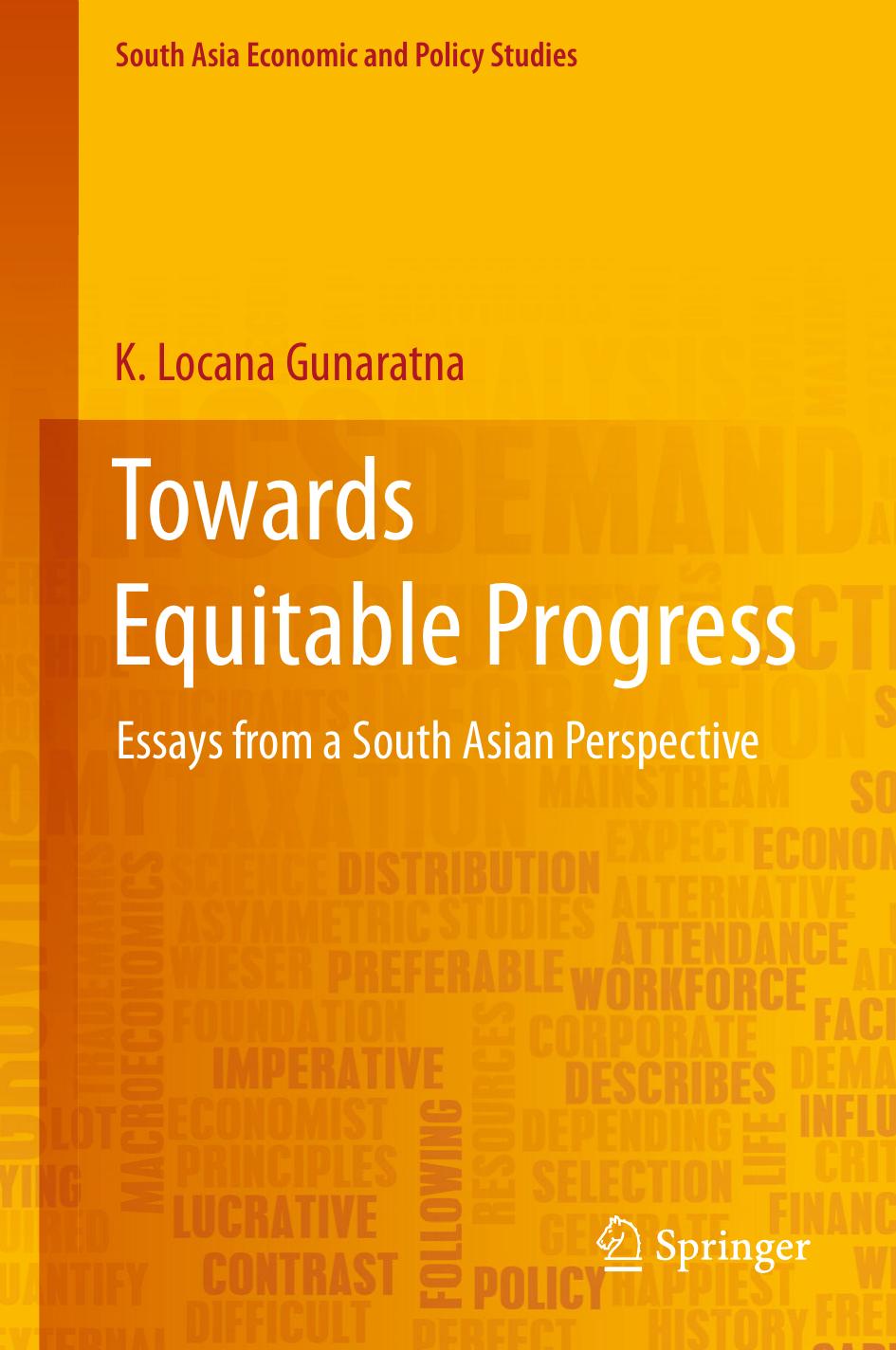
Author:K. Locana Gunaratna
Language: eng
Format: epub, pdf
Publisher: Springer Singapore, Singapore
Needed Responses to Climate Change
The main attempt in the international climate change conferences such as in those that led to and included the one held in Paris in 2015 was to arrive at an agreement with commitments merely to reduce the rate of increase in global warming. It was hoped to reach agreement internationally to ensure the increase in global warming would be brought down to 2% or less than the preindustrial level by the end of this twenty-first century. The present rate of increase is in excess of 3%. It is reckoned by responsible scientist that an increase of 4% or more by the year 2100 would lead to irreversible catastrophes worldwide. The most adversely affected, as is already the case, will be the LMICs. The current experience of climate change in South Asia includes sea level rise in the coastal areas, increased glacier melt in the mountainous regions and, generally across the region, the experience of more unseasonal weather patterns with an overall reduction in precipitation but an increase in its intensity. Some of these often result in a succession of floods, droughts, and food scarcities. These climate events are getting harder to predict and their impacts are much more difficult even to ameliorate.
Due to the geographic and other variations found among the countries of South Asia, the strategy that may need to be adopted in one country may not be directly applicable in another. The responses generally recommended by the internal agencies involve taking measures to mitigate the adverse impact and/or to adapt to them. Some South Asian countries have little choice but to adapt. It has to be anticipated that the impact of climate change will worsen with time. This may happen in different ways in the seven separate countries discussed here and even within each of them. How will all these many separate communities adapt? How can the respective governments help support adaptation? These are serious questions that need answers and these answers will not be easy to find. In this context, there is perhaps one strategy that may be applicable in most of these countries and their diverse circumstances. This common strategy involves moving the most vulnerable families out of harm’s way which inevitably requires reliance on spatial planning. It may thus be useful to examine spatial planning approaches that are being tested.
One such strategy that may be studied could be the proposed spatial planning exercise at national level in the Case Study based in Sri Lanka as presented in Chap. 10 of this book. It identified two “fragile areas” in the country which are most vulnerable to disasters of different kinds. These identified areas are two populated parts of the country, one in the upper reaches of the Wet Zone highlands particularly where unstable hillslopes exist. The hazards to be expected there are landslides, rockslides, mudslides, subsidence of the soil, and such like. The other identified fragile area consists of low-lying coastal lands which are exposed to erosion by the sea, sea level rise, severe storms and cyclones and such like events—natural and predictable or otherwise.
Download
Towards Equitable Progress by K. Locana Gunaratna.pdf
This site does not store any files on its server. We only index and link to content provided by other sites. Please contact the content providers to delete copyright contents if any and email us, we'll remove relevant links or contents immediately.
International Integration of the Brazilian Economy by Elias C. Grivoyannis(111321)
The Radium Girls by Kate Moore(12096)
Turbulence by E. J. Noyes(8121)
Nudge - Improving Decisions about Health, Wealth, and Happiness by Thaler Sunstein(7760)
The Black Swan by Nassim Nicholas Taleb(7199)
Rich Dad Poor Dad by Robert T. Kiyosaki(6727)
Pioneering Portfolio Management by David F. Swensen(6342)
Man-made Catastrophes and Risk Information Concealment by Dmitry Chernov & Didier Sornette(6141)
Zero to One by Peter Thiel(5873)
Secrecy World by Jake Bernstein(4804)
Millionaire: The Philanderer, Gambler, and Duelist Who Invented Modern Finance by Janet Gleeson(4539)
The Age of Surveillance Capitalism by Shoshana Zuboff(4355)
Skin in the Game by Nassim Nicholas Taleb(4309)
The Money Culture by Michael Lewis(4268)
Bullshit Jobs by David Graeber(4252)
Skin in the Game: Hidden Asymmetries in Daily Life by Nassim Nicholas Taleb(4052)
The Dhandho Investor by Mohnish Pabrai(3826)
The Wisdom of Finance by Mihir Desai(3792)
Blockchain Basics by Daniel Drescher(3641)
